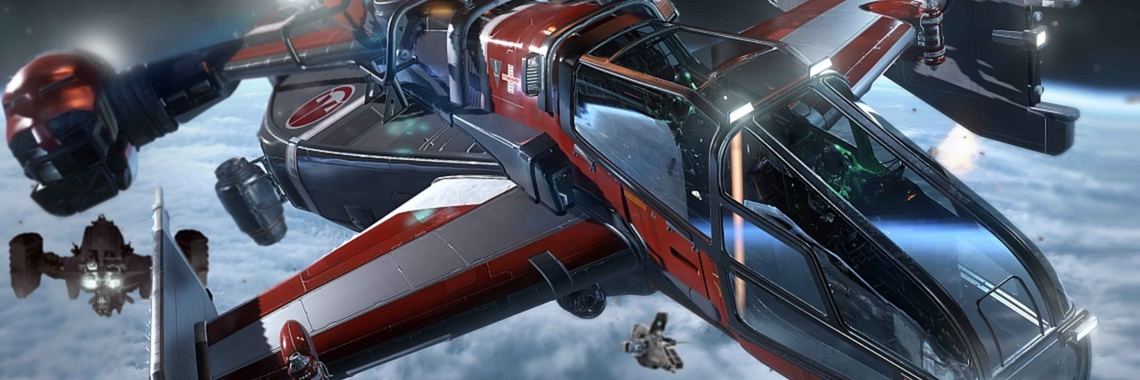
Craig still had his left boot unbuckled when the call came in. He had been back for twenty minutes and had announced that he intended to sleep at least six hours before the next flight. Now he was already in the cockpit of our rented Cutlass Red, the boot buckle open, already going through the launch checklist. The cup he had picked up from the table in the ready room on his way through he set down beside the console without looking. It was mine.
The Goodwill hung over the day side of Yela that night. Through the windows of the landing bay you could see the moon's crust of ice, gray and without luster, and beyond it, as a thin bright line, the belt of rock that surrounds Yela. The Goodwill had once been a Navy ship, an Endeavor of the Hope class, built to treat the wounded close to the front. The Navy had decommissioned her and sold her off with other surplus; Alice and I had taken her over and kept the name. Under the gray paint the old registration still showed through at the landing bay. Of the two operating rooms in the medical module, one was in service. Alice Cordell had signed it off in our first week aboard, instrument by instrument; the second she had left under its covers until there was a second team to work in it. We were six people on a ship built for many times that number, and we had made a habit of running only what a patient needed. Most of the cabins on the upper deck were not among those things. Mine had not been heated in months.
Myra Voss stowed two medical bags in the stern of the Red and then counted the fasteners. She did that twice before every launch. I had known her long enough not to speak to her while she did it. On my display, Rina Ortega was waiting. Her brother was stuck after an accident in a damaged ship in the belt. The remaining air, she said, would last eight minutes.
Rina's Call
"Eight minutes can't be done," Craig said without turning around. "Airlock, undocking, jump into the belt: six, if I set it clean. Then we still have to find him."
"We're flying anyway."
"Wasn't planning anything else." He sealed the landing bay's decontamination lock behind us and let the Red drop.
Up in the bay's flight control, Alice stood behind the glass, the headset already on. She had listened in on the call and had asked no questions. As the Red fell out of the bay I saw her turn away and head for the medical module, the headset still on; she took the emergency channel with her. I knew what she was going to do: bring the operating room up before it was clear whether we would need it. In Orison she had kept it that way for ten years, and nobody had ever counted how often the room had been ready for nothing.
I had started a timer on my mobiGlas, eight minutes, out of habit. It ran down while the quantum drive spooled up and Craig calibrated the target point in the belt. I watched it, although the number could no longer mean anything. It was the only figure we had.
In the background of Rina's transmission ran a steady hum. Someone calling from aboard a ship that is running out of air breathes fast and talks in short sentences; Rina talked in whole ones, and behind her nobody was breathing. I looked at Myra. She had heard the same and something more: the hum was too deep for a small ship. It came from station ventilation, and Myra knew it. Rina was not with her brother at all.
"Where are you?"
A pause. "Grim HEX."
I asked her to forward Jalen's last message. I wanted to read his own words. It came as a text message, forty minutes old. Jalen Ortega had reported an impact against the starboard hull, a blocked passage to the cockpit, pain in his left hand, no power left aboard and a ship that would no longer steer. There was nothing in it about eight minutes. Since that message he had not answered.
"If I just say accident, nobody comes," Rina said. Then, quieter: "Are you turning back now?"
"No," I said. "We're flying. From now on I only need from you what you know, not what you're afraid of." I handed the headset to Myra; establishing the situation was her work, and she did it better than I did. She asked Rina for the Kestrel's registration, the ship type, the number of people aboard and Jalen's last confirmed position. None of her questions contained an accusation. Meanwhile I read Jalen's message a second time. Pain in his left hand: conscious, then, and clear enough to write. No power, so no heating: after forty minutes the cold in the ship was more dangerous than the air. I had learned that in my first year as a freelance emergency physician, on an ore freighter. The man there had had air for a whole day and was still barely responsive after three hours, because nobody had thought of the heating. Since then I read "no power" as "cold". I passed both on to Alice, the injured hand and the cold, so that she could warm the recovery room. She acknowledged with a single word.
When Myra was done we knew we were looking for a MISC Freelancer, that Jalen was alone aboard and that his last position marker lay four kilometers from an abandoned mining field, which Rina marked for us.
Grim HEX lies in the belt of Yela. Everline Structures had built the station shortly after the system was opened up, inside a hollowed-out asteroid, as housing for the miners who were supposed to work the belt. When the work ran out, the station stayed; in 2938 it was officially closed, and other people took it over. To me, that night, it was above all a place from which Rina could not reach her brother in time. Myra had been born there. She had recognized the fan noise before Rina said the name.
The timer on my mobiGlas stood at zero. I switched it off. The number had never been right. What mattered was the cold.
Craig Goes In Closer
The jump ended in a field of shadows. From a distance the belt of Yela looks like a line; from the inside it is slowly circling rock, between which the stars fade in and out. In between hung ice dust, as thick as my grandmother's pumpkin soup, God rest her soul; you could have stood a spoon in it, and the scanner saw about as much through it as I did. Craig throttled back until the Red had almost no way on and let the scanner run. One contact in range: a hull, no power, no transponder, eight kilometers from the marker and still drifting away.
Craig Harker had flown combat missions for the UEE Navy. In October 2945 he had been deployed in the Vega system, after the Vanduul attack on Vega II. Of the escort flights afterward he occasionally told technical details: a failed radio, a wrong cargo code, a launch cleared too late. Of the people aboard the transports he had escorted, almost never.
He flew closer past the boulders than I liked. I saw the Kestrel only briefly between two dark surfaces: a Freelancer, the starboard side caved in, a torn-off antenna mount that scraped across the hull with every rotation. She was rolling slowly about her long axis. Craig tipped the Red onto her side and held her there while the damaged ship came back into view. Craig's dry tone from the landing bay had vanished.
"Airlock port side, midships. Two minutes, then she turns the side away from us."
"How close can you go?" I asked.
Craig pointed at the mount. "Thirty meters. Closer only if you want that thing to put the canopy in."
"Thirty. Myra and I go across on the line, you stay at the controls." How close was his decision; who went was mine. Myra clipped her bag to her harness while I was still saying it.
Aboard the Kestrel
The outer airlock door could be opened by hand and closed again behind us. Beyond it was dark and silent; only the emergency lighting glowed at floor level. The pressure held, the gauge on the inner door showed cabin atmosphere, but the air that met us when Myra cracked the door open was as cold as a refrigerated hold. Without power, the Kestrel had not been heated for almost an hour.
The inner door jammed. The frame had been bent in the impact; the gap was enough for an arm, not for a person. Beyond it, in the passage to the bunks, Jalen sat on the floor trying to close a damaged tool bag with his right hand. His left he held pressed against his chest. He was wearing his suit, the helmet beside him.
"Is anyone else aboard?" I asked through the gap.
"Can the bag come?"
Myra set the spreader Craig had given us at the last minute and bent the frame back centimeter by centimeter. When she called Jalen by his first name he looked up for the first time. Rina had told us how he reacted to strangers: he preferred to answer questions with a question.
I got through first and left the bag where it was. "The bag comes," I said. "First the hand, then the bag, then you." Jalen looked at me as if he had expected an argument and not gotten one. Then he set the bag down beside him himself and held out his left hand to me.
The bag hung half open; the zipper had torn out in the impact. Inside were tools and a set of spare fuses. "Will you look after it?" Jalen asked. "Half of it is Rina's." Myra pushed the bag closed as best she could and slung it over her shoulder.
The hand was swollen and deformed over the metacarpal. I splinted it. Jalen was shivering, and the fingers of his right hand were white with cold; mildly hypothermic, no more; but it could not have gone on much longer. The readout on his suit stood almost at zero: in the hour without ship's power the heating had drained the battery. Myra already had a full one out of her bag. Since the ore freighter, every one of our emergency bags carries a suit battery, and Myra counts it before every launch. She swapped it in, turned the heating to maximum, put his helmet on and told him how long it would take before he felt warmer; that took his mind off the pain. Then we brought him through the airlock and back along the line to the Red. Craig had followed the wreck's rotation and held the distance to the meter. Behind us the Kestrel kept turning, and the torn-off mount swept silently across her hull with every rotation.
In the Red we laid Jalen on one of the two beds. Myra stayed with him and relayed his vitals to the Goodwill the way she had done for thirteen years on the way in to Orison General. Craig set course for the Goodwill. By now a message from Rina was waiting on my display: Myra had asked her for the Kestrel's registration, and Rina had sent the ship's papers. Fourteen pages; a single line would have done for a registration. I left them unopened. Right now this was about Jalen, not his ship.
Jalen wanted to go back to Grim HEX. Myra told him we were flying to the Goodwill first so that a surgeon could look at the hand. He was silent for the rest of the flight and asked his next question only on approach: who would fly him back to his sister afterward.
Goodwill, 04:10
The Goodwill's landing bay lay under her hull, with room for two Reds. Craig set her down on her berth; the second was empty. Sooner or later we would need a second rescue ship. The decontamination lock took its minute. Jalen asked meanwhile whether this was a hospital. "Half of one," Myra said. Half of the Goodwill went unheated. The operating room was in the other half.
Alice was waiting for us at the end of the passage to the medical module, in scrubs, her hands still dry. Behind her the lights were on in the part of the module we used: the receiving room, the scanner, the one operating room, the recovery room with four beds. She looked at Jalen, not at me, and asked him three questions before he could fit in his first counter-question: when he had last eaten, whether he took any medication, whether he was allergic to anything. He answered all three. I gave her the rest in four sentences: time of the accident, the hour in the cold, the readings from the Red, the medication he had received.
Alice Cordell and I had worked side by side at Orison General for ten years, she in the operating room, I in the emergency department, and we had left the hospital on the same day. She is a trauma surgeon and, on the Goodwill, the chief physician: she decides what is done in her operating room and what is not. I am an emergency physician. I bring her the patients and give the anesthesia when there is nobody who does it better.
She put the hand under the scanner. Three metacarpals broken, two of them displaced, the skin intact. No circulation problems, no nerve deficits. Alice turned the image twice, then straightened up.
"Tonight," she said. "Two plates, maybe three. Right now I can still get at the fragments before the hand swells shut. If I wait, I wait a week, and all that time the pieces move against each other."
Jalen heard the word plates and sat up. "And if I say no?"
"Then we talk about it again. It won't change anything about the hand." Alice took the splint off and looked at the fingers, one after the other. "Can you move the thumb? Good. This one? Not that far. That's enough." Then she looked at him properly for the first time. "The hand first. We'll talk about everything else when you have two of them again."
Myra was already at the cabinets. Thirteen years of ambulance service, two years at Alice's table; she had been scrubbing in since we had the Goodwill, and she knew the order in which Alice wanted her instruments laid out. Craig stood in the doorway of the module, the boot now buckled. Ivo was asleep over on the Dauntless, and Nadia was on the supply run to Orison with the MAX; apart from Craig there was nobody aboard who could have flown the Red. He had been on his feet for twenty-two hours. Alice looked at him and told him to go and sleep; if she needed a pilot, she would wake him. He looked at me until I nodded.
"Your coffee's in the Red," he said. "I didn't touch it." It was not true, and we both knew it.
Room One, 04:50
I write little about what happens in the operating room, because I am not the main person there. I sat at the head end, with the readings in front of me and Jalen's breathing in my ear, and watched Alice open the hand. She hardly speaks while operating. What she says is addressed to Myra, and it is the names of instruments, never explanations. In Orison she had had a room with six people. Here she had Myra and me, and she had rebuilt the routine so that three were enough. She had practiced it motion by motion in the first weeks on the Goodwill, on evenings when there was no patient.
After twenty minutes Jalen's blood pressure dropped. Not much, but faster than I liked; a man who has sat for an hour in a cold ship has little reserve. I gave him fluid and a drug that narrows the vessels again, and told Alice the number. "Do you need a pause?" she asked. "No. Give me two minutes." She worked on without looking up. After two minutes the reading was back where it belonged. In Orison a whole anesthesia team would have stood at the head end for that. Here I sat there, and Alice relied on it.
The second plate was seated after an hour. The third she did not need; the third fracture was not displaced, and she left it as it was. When she closed the hand she looked at the clock for the first time.
"Six weeks before he works with it," she said. "Two before he tries anyway. That's your department then."
She meant Myra. Myra nodded without looking up from the instruments she was already counting.
Jalen woke in the recovery room. Alice usually slept there herself when the night was short; her cabin upstairs was as cold as mine. Tonight she would take the bench in the ready room. The first thing he asked was whether his ship was still there. Myra said it was drifting in the belt where we had found it, and nobody had touched it. The second thing he asked was whether the bag had come along. It was standing beside the bed.
Goodwill, 06:30
After the operation I talked to Rina from flight control above the landing bay, from where you can see the belt. She had not left the comm since our launch. I told her the most important thing first: that the hand had been operated on, that Alice was satisfied and that Jalen was asleep. Then she apologized for the eight minutes. I wanted to explain to her what her false time could have set off: a pilot who goes in too close; a doctor who makes the wrong decision in a passageway because he believes he has no time. I let her finish first.
She had already tried two other contacts. One had been unreachable. The other had asked questions that had nothing to do with Jalen and, in the end, declined. On the third attempt she had been afraid of being turned away again. So she had given us a number nobody questions.
I explained to her why we needed accurate information, and that next time she only had to tell us what she knew. She asked when she could come. I said we would fetch her as soon as one of us flew into the belt. Rina was silent for a while. Then she asked about the ship, and I told her that Ivo would take a look at it. Ivo did not yet know how lucky he was.
Craig was waiting down in the bay by the Red, although Alice had sent him to bed. My cup was still next to the console, where he had set it down at launch, cold and almost empty. When I reached for it, he pulled it toward himself once more and drank the rest.
"Next time I'm bringing two cups," I said.
"Good idea," Craig said, putting the empty cup back. "Then I won't have to share."
Myra handed me a bottle of water and put Rina's papers on my display, the ones I had not opened since the belt.
The Kestrel did not belong to Jalen alone. Rina held the larger share, and she had put up that share as security for a private loan. If the ship was written off, the security was gone. That was why, in the end, Rina had asked about the ship and not only about her brother. And that was why the fourteen pages: she had hoped that people who pull the injured out of the belt and repair wrecks would take a look at the Kestrel too. She had lied because of Jalen. She had sent the papers because of the ship.
Alice came into the bay, the scrubs swapped for a jacket, and sat down on the Red's step. She was drinking tea, from a cup nobody else touched, because it was hers and because it was tea. I told her Rina had asked about the ship.
"Of course she did," Alice said. "The hand is taken care of. The ship isn't."
Whether it could still be saved, only one of us could judge, and I had just promised his work to someone without asking him. I would settle that with Ivo first thing, before he heard it from anyone else.
